Saturday, February 11, 2006

Grapefruits, penises and pigs, oh my!

No 'buoi' please, we're Vietnamese

HANOI (Reuters) - What do a Vietnamese grapefruit seller and a gender activist have in common?

Both have had applications to register Web site addresses rejected by authorities because the names contained words which could lead people to believe they were pornographic sites.

The fruit seller was tripped up by the tonal Vietnamese language, in which 'buoi' can mean either a grapefruit or slang for penis.

State-run Vietnam Television said late on Friday that the gender activist had wanted his Web site to be called sex.com.vn, which the country's Internet domain control body rejected. Pornography is banned in the Communist-ruled country.

Sites containing 'lon', which can mean either 'pigs' or 'vagina' depending on the tone, and 'xxx' are also not allowed, the television said.

I'm posting this text from Reuters as a joke, but any Vietnamese reader would tell you that the situation is not that simple. «'Buoi' can mean either a grapefruit or slang for penis» says Reuters. Well, actually, no. 'Buoi' doesn't mean anything in Vietnamese. A grapefruit is «bưởi» and a penis is ... uh.. look, all you need to know is: it's not spelled «buoi». Same thing with pigs and vaginas: not only are the tones different, the spelling is completely different. The real problem is that the domain registration system is based on the Latin alphabet and therefore cannot accomodate languages like Vietnamese that use a modified romanized system of writing.

But I've got to admit, learning to recognize and reproduce accurately the different tones is not an easy task for people used to non tonal languages. During the Vietnamese/American war in the 60s, the national TV station in Saigon used to broadcast a show hosted by American «advisers» who would laboriously read the daily news in Vietnamese. The show was very successful, if only for its comical value, because once in a while, the poor anchormen would use the wrong tones, with hilarious results, of the pigs = vaginas variety. I remember one of their most frequent mistakes was to pronounce «quân» neutral tone (troops, soldiers, etc.) as «quần» third tone (pants), so they would announce that the pants did this, the pants did that, we're expecting more pants next month, etc. And hilarity would ensue in Vietnamese households.


Saturday Poll


What would you rather see me post here: random nice images (Illuminated Angkor Watt), cute animal pictures (Baby penguins) or political humor (Quadruple denials)?

Wait, there's no way for you to vote, so never mind. It was just an excuse for me to post some of my favourite pics. Teeheeheee!

Thursday, February 09, 2006

Ceux qui ne comprennent ni l'islam ni la liberté

Article de Soheib Bencheikh, publié dans le Monde de ce matin [http://tinyurl.com/buvgf]
Théologien, Soheib Bencheikh, ancien mufti de Marseille, est directeur de l'Institut supérieur des sciences islamiques (ISSI).


uite à la publication des caricatures touchant à la personne du Prophète, pour des raisons probablement malintentionnées, la réaction de certains musulmans se situe au-delà du surréalisme.

Des régimes "musulmans" et certaines organisations "islamiques", comme l'UOIF en France par exemple, vont jusqu'à l'exigence pathétique d'excuses solennelles des chefs de gouvernement des pays où les caricatures ont été publiées. En France, l'événement a pris des proportions "élyséiesques".

Cette revendication, insolite de mémoire d'Arabe, suscite bien des interrogations. Ces musulmans ignorent-ils l'enseignement coranique, qui nous incite à transcender les polémiques ? N'ont-ils pas dans le coeur le verset "et lorsqu'ils (les croyants) sont apostrophés par les ignorants, ils disent : Paix" ? Ne savent-ils pas que le Prophète lui-même a subi les affres et les injures les plus humiliantes ? Lorsque les polythéistes de son époque le qualifiaient de fabulateur et d'imposteur, il ne leur a pas tordu le cou mais leur a répondu : "Dieu sera juge entre nous le jour de la rétribution."

Ces musulmans ignorent-ils que l'islam, qui a traduit et étudié les philosophies les plus athéistes et argumenté face aux idéologies les plus redoutables, destructrices et semeuses de doutes, ne saurait trembler aujourd'hui devant un dessin caricatural et de mauvais goût ?

Pourtant, une religion sûre d'elle-même, convaincue de sa solidité, ne peut fuir les critiques et les mises en cause. Alors, comment veulent-ils que les bases de l'islam vacillent aujourd'hui devant une futile provocation ?

Quant à l'autre ignorance, elle est plus grave encore. Ces musulmans ignorent-ils que la liberté d'expression la plus totale est un édifice commun à toutes les pensées, construit pour toutes les convictions, même les plus contradictoires et inassimilables ? Tout un chacun a droit de cité, qu'il soit beau ou laid, fou ou sage, provocant ou responsable. Faut-il rappeler que c'est grâce à cette même liberté d'expression que l'islam lui-même peut élever la voix à tout moment dans les pays démocratiques ? Qui empêche un musulman, en France ou ailleurs en Europe, de proposer ses valeurs ? Qui entrave un croyant qui veut publier ses convictions ? N'est-il pas permis à tous les citoyens, y compris les musulmans, de critiquer tout projet ou de promouvoir toute action ? Au moment où l'islam n'a pas bonne presse en Occident, c'est grâce à cette même liberté d'expression que nous, musulmans, pouvons nous défendre pleinement.

Mon étonnement est grand lorsque je vois que toute une mobilisation diplomatique, inédite dans l'histoire des pays musulmans, se met en marche pour faire pression sur des chefs d'Etat et de gouvernement afin d'obtenir leurs excuses et leur mea culpa. Pourtant, ces mêmes gouvernants et ces mêmes chefs d'Etat n'ont jamais été un jour à l'abri de la satire la plus blessante et de la caricature la plus caustique.

Lorsque certains Etats arabes boycottent par des mesures diplomatiques et économiques le Danemark, pays paisible et pacifique, que penser de leur docilité envers les Etats-Unis à qui ils sont malheureusement livrés, poings liés ?

Quant au soutien du rabbinat et de l'Eglise en France, il ne peut que susciter les remerciements vifs et sincères des musulmans pour cette solidarité affichée. Mais on aimerait l'avoir aussi pour les hommes et les femmes, musulmans de Palestine, d'Irak, de Tchétchénie et d'ailleurs, privés de leurs droits fondamentaux et victimes d'atteinte à leur dignité.

Le vrai débat est ailleurs. Il s'agit, en réalité, de la juxtaposition de deux droits absolus : le droit d'avoir des convictions religieuses qui soient complètement respectées et ne soient ni fustigées ni stigmatisées, et le droit de s'exprimer à tout moment, notamment pour commenter ou critiquer des projets sociaux concrets et des actions politiques palpables.

Quant à la conviction intime ou métaphysique des gens, je ne sais pas si elle est du ressort de la liberté d'expression. Réfléchissons !

Wednesday, February 08, 2006

Lesson From Vietnam

A University of Minnesota medical student goes to Vietnam to discover his heritage and learn about caring for the poor.

By Gail Rosenblum

HANOI, Vietnam —It’s 8 a.m. at the National Institute of Pediatrics in Hanoi. The finest children’s hospital in Vietnam, it has no elevator and all of the medical manuals are photocopied.

Sixteen men in white coats sit in castoff mustard-yellow chairs and discuss the morning’s cases. A nurse brings tea in a cheerful flowered carafe, pours it into 10 stained glasses, and sets the carafe next to an ashtray stuffed with cigarette butts.

The doctors have been joined this morning by two American visitors.

Phuong Nguyen, a 24-year-old medical student from the University of Minnesota class of 2004, has been at the hospital for two weeks, observing and assisting in surgery. For two weeks prior, he lived in a small province to the north, joining a group of volunteer physicians fixing cleft lips and palates. Born in a refugee camp in Indonesia in 1979 as his educated, middle-class parents fled the communist takeover of Vietnam, and raised across the world in Maplewood, Minnesota, Phuong had never seen his parents’ home country. His desire to do so was keen.

In his third year of medical school in 2003, he learned about a humanitarian medical program sponsored by the American Academy of Pediatrics called Project Vietnam. For the young man raised in privilege, this was the perfect avenue for return. “To have come back solely as a tourist would have felt empty,” he says.

But Phuong’s 57-year-old mother, Mai, who stands at his side, cherished the opportunity to return as a tourist—to visit distant cousins, shop, and sun on the beaches—after her harrowing escape 25 years ago. Still, she smiles as she confesses to another agenda. “I come to make sure he doesn’t get married off,” she says with a laugh. Out of earshot, her voice turns serious. “He’s a young man who is living in America, raised in America. He’s very honest, not knowing any tricks behind the scenes. Here, people will try to take advantage. He says, ‘Don’t worry, Mom.’ But, as a mom, I still worry.”

Phuong introduces Mai to the group and takes his place in a seat across the room. There will be 11 surgeries today, including one on a 2-month-old boy with a brain hemorrhage and another on a 14-year-old girl with a cerebral tumor. Most of the children’s parents are shopkeepers and farmers. Nearly all are destitute. No one has medical insurance, so they must pay out of pocket. Many have had to carry their children on buses or strap them onto bicycles. Some travel as far as 100 miles to get to the tertiary-care hospital; others come from nearby villages approximately 20 miles away.

Lessons Not Taught in Class

To get the most out of their limited resources, the surgeons have learned tricks they would never find in a medical manual, photocopied or otherwise. A single suture costs 40,000 dong, or $2.80 in U.S. dollars, seemingly a pittance. But the annual income of a Vietnamese family averages $270. To compensate, these doctors are among the most skilled in the world at closing a wound in two or three tidy stitches instead of eight or 10.

If a family arrives in clean clothes, signaling relative affluence, the doctors hike the price of care from perhaps $30 to $300. They then save the extra money and use it to cover expenses for the next family, who will undoubtedly arrive with no way to pay.

Phuong suggests that his mother wait for him outside the operating room. She wants to stay. OK, he agrees, telling her not to touch anything because all the equipment has been sterilized.

“I know that,” she says, rolling her eyes and flipping her hand in the direction of her son. Mai, who earned a biochemistry degree in 1972 in Saigon (now Ho Chi Minh City, 700 miles south of Hanoi), scrubs and stands near the wall. She, too, wanted to be a doctor, but the rigors of study intimidated her. When Phuong was 2, she bought him a toy medical kit. When her son struggled with biology in high school, she taught him tricks for memorizing Latin words until he was “the top of his class.”

Phuong graduated from the University of Minnesota in two years with a degree in neuroscience, spent one year doing research at Harvard University, and began medical school in 2000.

For Phuong the main attraction of coming to Vietnam was the promise by doctors who had participated in Project Vietnam that he would see things here that he wouldn’t see during an entire two-year fellowship in the United States. He hasn’t been disappointed. In one afternoon, for example, he saw a choledochal cyst, imperforate anus, two cases of patent ductus arteriosis, two children with ventricular septal defect, one child with syndactyly, an anovaginal fistula, two teratomas, and much more. Some of those conditions would never be seen in the United States.

Through the Eyes of an American

The operating room is a study in contrasts. The overhead light and LCD monitors are state of the art, but the scissors are dull and missing tips. The sheets on which children lay, the plastic gloves, and all of the instruments will be washed and reused. Surgeons use sutures made of cotton as opposed to silk, nylon, or absorbent materials.

These little things weigh heavily on Phuong’s conscience. Until coming here, he never considered the “enormous waste” of materials used in surgery. “We use dozens of sutures, throw away towels, so many things,” he says.

Suddenly, surgery stops. The power has gone out. “Merde!” the lead surgeon curses in French. Seconds later, the power returns. The team continues. Power will go out another six times before the surgery is completed. Blackouts are common in Vietnamese hospitals, where back-up generators are at least 20 years old and often unreliable.

Pediatric surgeon Nguyen Thanh Cong, M.D., who trained in Japan, was performing heart surgery on an infant in the room next to Phuong’s when the power went out. Asked later about this particularly troublesome challenge, he answered simply: “Vietnam is a poor country.”

And, with that, the conversation ended.

Outside surgery, the narrow hallways are lined with anxious parents dressed in blue and brown striped hospital pajamas that resemble jail uniforms. Some sleep on the floor, others pull from bags miniature bananas and baguettes —the latter a reminder of decades of French colonial rule. One sallow-cheeked father sits on a flattened cookie box. A woman screams at a man as both push frail children down the hall. She thinks he has stolen her baby’s blanket. Her howls fill the hallway until another man steps in and demands that she stop.

When their children get through postop, parents maneuver them on rolling metal stretchers lined with straw mats to recovery rooms with eight or 10 beds. Sometimes two children share a bed.

Phuong, in his white coat, and Mai, clutching her purse, step into a recovery room where a mother nurses her 2-year-old son, who is dressed in Harry Potter pajamas.

Phuong and Mai have vaulted to near celebrity status as they walk from recovery room to room. Parents look up in hope of having a conversation with the unusual Vietnamese speakers with their lighter skin and rosy cheeks. (Visitors such as these two are known as “Viet Kieu,” an uncomplimentary term for the ones who left.)

Phuong delights his mother as he passes out toys and bite-size chocolates to the children. “This morning I tell Phuong to bring candy,” Mai says. “He say, ‘Mom, you are goofy.’ But look at this! Now they are happy.”

Amid the poverty, mother and son are moved by the effortless nurturing they see everywhere they look. Parents never leave their children’s sides, lying with them, stroking their hair and skin, cooing to them. Before coming here, Phuong spent two weeks in Hoa Binh, a province in northern Vietnam, with Project Vietnam. There, the group of surgeons Phuong worked with performed 18 cleft lip and palate surgeries but had to turn down dozens more patients when resources ran out. That still haunts the handsome young medical student, as many of the patients were teenagers only a few years younger than he with holes in their upper lips that caused food to ooze out. “Please fix this,” their parents begged. “Otherwise, our child has no chance to marry.”

During his time in Hoa Binh, Phuong translated for one American doctor and served as a scrub nurse for others. Team members brought their own anesthesia medications, ambu bags, and surgical instruments. Because of the hospital’s antiquated power supply, there often was insufficient light to do the surgeries, so Phuong would wear a Halogen headlamp he purchased at REI on his forehead. One doctor, absent a ventilator, squeezed a hand-held balloon for 10 straight hours during surgery. After surgery, Phuong carried the children up a flight of stairs to recovery.

Not surprisingly, Phuong feels a universe away from his $80,000 U.S. medical school education. “My hands aren’t exactly calloused from manual labor,” he says, humbled by having grown up in such affluence and seeing how different his life would have been had his family decided to stay in Vietnam.

Phuong’s plans after graduation were to begin a five-year residency in general surgery at New York University Medical Center. But his Vietnam experience has already had a lasting impact. “I’d really like to come back and contribute something,” he says. “I feel a responsibility to make good.”

Mai is deeply proud of her son—and of his desire to one day return to his home country and make a difference. “As I’m watching him, I’m thinking about a little kid running around on an [Indonesian] island, and he grew up and he’s a doctor… And he’s right. He needs to contribute to Vietnam. It’s his country.” MM

Gail Rosenblum is a Minneapolis writer. She and photographer Judy Griesedieck traveled to Vietnam in April as part of a four-year project on the University of Minnesota Medical School class of 2004. Other stories about the class of 2004 have been published in the Minneapolis Star Tribune.

Giving Kids a Chance

Project Vietnam, the international health program of the American Academy of Pediatrics, was founded in 1996 by California pediatrician Quynh Kieu, M.D., and her husband, anesthesiologist Chan Kieu. When the United States resumed diplomatic relations with Vietnam that year, the Kieus returned to their home country in the hope of improving the dismal state of health many Vietnamese children suffered.

By 1998, they were making regular trips to Vietnam with fellow volunteers to perform surgeries on children with cleft lips, cleft palates, and strabismus. In 2000, they added cataract surgeries and ear exams to Project Vietnam’s offerings.

Among the biggest threats to children in Vietnam’s provinces, as well as in larger cities including Hanoi, is brain hemorrhage caused by a lack of Vitamin K. A study of Vietnamese children by the National Institute of Pediatrics in 2000 found that they had a deficiency rate that was 20 times higher than the rate in developed countries. They also had the highest deficiency rate in Asia. Of 1,325 infants hospitalized in Hanoi between 1991 and 1998, more than 17 percent died and 40 percent showed long-term damage from lack of Vitamin K.

With Project Vietnam’s support, the institute launched demonstration projects in two districts with the highest incidence of Vitamin K deficiency hemorrhage, Ha Tay and Hanoi. With the support of AmeriCares, VNHELP, the Vietnamese Pharmacists Association, International Children Assistance Network, and Lua Viet, some 120,000 doses of Vitamin K have been donated to the program, and about 25,000 babies in the two districts have received injections. Last year, the Ministry of Health adopted administration of Vitamin K for newborns as a national policy. The vitamin is currently being given to newborns in some communal health centers.

In addition, Project Vietnam leads programs to carry out nutrition assessments of children at elementary schools. Volunteers tell wrenching stories of children complaining of stomachaches when, in reality, they were simply hungry. More than 90 percent of the children studied did not get milk and were, not surprisingly, at the low end for growth. In addition, some children ate just once a day. To this end, Project Vietnam has begun a school-based project to provide nutrition support to poor families. —G.R.

For more information on Project Vietnam go to www.projectvietnam.net or write Project Vietnam, 12377 Lewis Street, Suite 103,Garden Grove, CA 92840; phone 714/641-0850.

Facts on Health Care in Vietnam

The health care system in Vietnam is a four-tier system, with 826 state-owned hospitals (central, provincial, and district), including 29 central facilities such as the National Institute of Pediatrics in Hanoi. The fourth tier is made up of five private hospitals and two foreign-owned hospitals. The country also has 19,500 private clinics and medical centers, and 10,165 communal health centers that serve collective communities of up to 10,000 people. National preventive programs such as immunization, maternal and child care, safe water, maleria prevention, family planning, and HIV prevention are managed at the central level.

Since reforms began in 1987, Vietnam has successfully achieved steady economic growth, resulting in a rapid reduction in poverty. The most recent figures on living standards show that the ratio of absolute poor has dropped from 51 percent of the population to around 35 percent in 1998. Despite strides in economic progress, the rural health sector has remained stagnant. Under the old central-planning system, social services were free, and the state was the sole provider and funder of care. Under the new system, user fees were introduced and private providers allowed to operate. People living in urban areas rely on social insurance and social welfare, while the rural social protection system depends largely on family support and informal mechanisms combined with public poverty alleviation programs. Increasingly, people living in rural areas have to shoulder a large portion of the costs of health services as user fees have increased steadily. Vietnam still feels uneasy about private sector involvement in the delivery of health services.

According to the latest health care statistics released by the Ministry of Health in 2003, each person in Vietnam spends an average of 217,300 dong annually ($14) on check-ups and treatment. Each person falls ill 1.5 times a year, and people of working age take an average of 5.8 days of leave every year for health reasons.

Among children under age 5, 30 percent suffer from malnutrition and 1.3 percent from obesity. Nearly 80 percent of the obese children live in urban areas. Monthly per capita income of Vietnamese people was 357,000 dong ($23) in 2001-2002.

Health care training is carried out in eight medical and pharmaceutical schools and 25 secondary schools and produces approximately 2,000 graduates annually. Training and management concepts are outdated, and there are few in-service training sessions. A physician earns about $35 a month; a nurse, $32, in urban areas.

This year, the government started an initiative to implement national health insurance. However, the system differs from province to province. Ha Nam province, for example, chose to provide matching funds to purchase coverage for more than 90,000 indigent residents, giving them access to health care facilities of their choice, while Lang Son set aside government funding to reimburse for health services as incurred. Nonetheless, this is a crucial step to shore up the safety net and reverse disturbing trends evident in the country’s health sector.


Reprinted from an article published by the Minnesota Medical Association:
file:///c:/windows/Temporary%20Internet%20Files/OLKA2E1/Rosenblum.htm
[Thank you, Fongue!]

Tuesday, February 07, 2006

Bonjour Vietnam


Pham Quynh Anh est une jeune chanteuse vietnamienne (19 ans et bourrée de talent), née à Liège en Belgique, dont la chanson Bonjour Vietnam (de Marc Lavoine) est en train de connaître un succès fulgurant auprès de la diaspora vietnamienne.

Plusieurs sites web et blogues ont affiché des articles sur Quynh Anh, et nombreux sont les Vietnamiens expatriés qui se reconnaissent dans les paroles tendres et subtiles de sa chanson.

Le site Tuoi Tre Online http://tinyurl.com/99wc9 a consacré des pages entières à la jeune chanteuse (en vietnamien, sorry!) et il suffit de lire les commentaires des lecteurs pour se rendre compte de l'engouement du public.

Visual Guy a créé un «diaporama» musical avec la douce voix de Quynh Anh et des photos superbes du Vietnam: http://www.visualgui.com/motion/BonjourVietnam.html.
J'invite tous mes lecteurs, vietnamiens ou non, à cliquer sur le lien et à aller se noyer dans la splendeur des images et de la musique.

Funny messages from your computer

I'm only posting the funnies I understand...[Go ahead, say it!]. You can find the rest here: http://thedailywtf.com/


Sunday, February 05, 2006

Sunday Musing

Super Bowl
I'm so ignorant of and indifferent to this quintessential American ritual that I don't even know when it takes place. Having been bombarded all week with incessant announcements and commercials about it, I thought it was due yesterday and was surprised not to find the results in the Sunday issue of the New York Times. It's a bit like reading about the Hadj pilgrimage in Saudi Arabia or the Pamplona Bull Running in Spain: exotic and interesting for about 2 seconds.

Mule Dogs
Most people were incensed to learn that drug dealers are using puppies to transport drugs accross the borders. Then they felt ashamed that they were more upset at the idea of canine mules than human mules. One does get used to human misery by reading or watching the news about it every day.

Blasphemous cartoons
What he says.

«The case for mocking religion
By Christopher Hitchens [http://www.slate.com/id/2135499/]

As well as being a small masterpiece of inarticulacy and self-abnegation, the statement from the State Department about this week's international Muslim pogrom against the free press was also accidentally accurate.
"Anti-Muslim images are as unacceptable as anti-Semitic images, as anti-Christian images, or any other religious belief."
Thus the hapless Sean McCormack, reading painfully slowly from what was reported as a prepared government statement. How appalling for the country of the First Amendment to be represented by such an administration. What does he mean "unacceptable?" That it should be forbidden? And how abysmal that a "spokesman" cannot distinguish between criticism of a belief system and slander against a people. However, the illiterate McCormack is right in unintentionally comparing racist libels to religious faith. Many people have pointed out that the Arab and Muslim press is replete with anti-Jewish caricature, often of the most lurid and hateful kind. In one way the comparison is hopelessly inexact. These foul items mostly appear in countries where the state decides what is published or broadcast. However, when Muslims republish the Protocols of the Elders of Zion or perpetuate the story of Jewish blood-sacrifice at Passover, they are recycling the fantasies of the Russian Orthodox Christian secret police (in the first instance) and of centuries of Roman Catholic and Lutheran propaganda (in the second). And, when an Israeli politician refers to Palestinians as snakes or pigs or monkeys, it is near to a certainty that he will be a rabbi (most usually Rabbi Ovadia Yosef, the leader of the disgraceful Shas party), and will cite Talmudic authority for his racism. For most of human history, religion and bigotry have been two sides of the same coin, and it still shows.

Therefore there is a strong case for saying that the Danish newspaper Jyllands-Posten, and those who have reprinted its efforts out of solidarity, are affirming the right to criticize not merely Islam but religion in general. And the Bush administration has no business at all expressing an opinion on that. If it is to say anything, it is constitutionally obliged to uphold the right and no more. You can be sure that the relevant European newspapers have also printed their share of cartoons making fun of nuns and popes and messianic Israeli settlers, and taunting child-raping priests. There was a time when this would not have been possible. But those taboos have been broken.

Which is what taboos are for. Islam makes very large claims for itself. In its art, there is a prejudice against representing the human form at all. The prohibition on picturing the prophet—who was only another male mammal—is apparently absolute. So is the prohibition on pork or alcohol or, in some Muslim societies, music or dancing. Very well then, let a good Muslim abstain rigorously from all these. But if he claims the right to make me abstain as well, he offers the clearest possible warning and proof of an aggressive intent. This current uneasy coexistence is only an interlude, he seems to say. For the moment, all I can do is claim to possess absolute truth and demand absolute immunity from criticism. But in the future, you will do what I say and you will do it on pain of death.

[snip] I am not asking for the right to slaughter a pig in a synagogue or mosque or to relieve myself on a "holy" book. But I will not be told I can't eat pork, and I will not respect those who burn books on a regular basis. I, too, have strong convictions and beliefs, and value the Enlightenment above any priesthood or any sacred fetish-object. It is revolting to me to breathe the same air as wafts from the exhalations of the madrasahs, or the reeking fumes of the suicide-murderers, or the sermons of Billy Graham and Joseph Ratzinger. But these same principles of mine also prevent me from wreaking random violence on the nearest church, or kidnapping a Muslim at random and holding him hostage, or violating diplomatic immunity by attacking the embassy or the envoys of even the most despotic Islamic state, or making a moronic spectacle of myself threatening blood and fire to faraway individuals who may have hurt my feelings. The babyish rumor-fueled tantrums that erupt all the time, especially in the Islamic world, show yet again that faith belongs to the spoiled and selfish childhood of our species.

As it happens, the cartoons themselves are not very brilliant, or very mordant, either. But if Muslims do not want their alleged prophet identified with barbaric acts or adolescent fantasies, they should say publicly that random murder for virgins is not in their religion. And here one runs up against a curious reluctance. … In fact, Sunni Muslim leaders can't even seem to condemn the blowing-up of Shiite mosques and funeral processions, which even I would describe as sacrilege. Of course there are many millions of Muslims who do worry about this, and another reason for condemning the idiots at Foggy Bottom is their assumption, dangerous in many ways, that the first lynch mob on the scene is actually the genuine voice of the people. There's an insult to Islam, if you like.

The question of "offensiveness" is easy to decide. First: Suppose that we all agreed to comport ourselves in order to avoid offending the believers? How could we ever be sure that we had taken enough precautions? On Saturday, I appeared on CNN, which was so terrified of reprisal that it "pixilated" the very cartoons that its viewers needed to see. And this ignoble fear in Atlanta, Ga., arose because of an illustration in a small Scandinavian newspaper of which nobody had ever heard before! Is it not clear, then, that those who are determined to be "offended" will discover a provocation somewhere? We cannot possibly adjust enough to please the fanatics, and it is degrading to make the attempt.

Second (and important enough to be insisted upon): Can the discussion be carried on without the threat of violence, or the automatic resort to it? When Salman Rushdie published The Satanic Verses in 1988, he did so in the hope of forwarding a discussion that was already opening in the Muslim world, between extreme Quranic literalists and those who hoped that the text could be interpreted. We know what his own reward was, and we sometimes forget that the fatwa was directed not just against him but against "all those involved in its publication," which led to the murder of the book's Japanese translator and the near-deaths of another translator and one publisher.

[snip] There can be no negotiation under duress or under the threat of blackmail and assassination. And civil society means that free expression trumps the emotions of anyone to whom free expression might be inconvenient. It is depressing to have to restate these obvious precepts, and it is positively outrageous that the [U.S.] administration should have discarded them at the very first sign of a fight.»


For another point of view: http://stevegilliard.blogspot.com/
Nordic uproar at Syrian protests
By Steve Gilliard

«I have been amazed at the way people, first, refuse to understand that depicting Muhammad in any form is a grave insult, second, this was done by a right wing newspaper to piss people off, and third, how shocked Europeans are at the way Muslims feel about a grave insult to their religion.

Now, the Europeans play the innocent party, and people suggest that Muslims should leave if they don't like being insulted in the West

American missionaries routinely go to China and deliver bibles, even though the government prohibits it, Yet, if the Chinese should jail one, all hell would break loose. Why doesn't the West respect Chinese customs?

But the fact that Muslims are in Europe is simple: they were invited. Scut work was too much for Europeans after the war, so they invited in Muslims to clean their streets, build their cars and do the other things Europeans didn't want to do.

Six countries in Europe had colonies with large Muslim populations: France, the UK, Holland, Germany, Italy and Spain.

They exploited their lands, murdered their people, and ruled them with an iron fist. French muslims died to liberate France from the Nazis, Indian and Pakistani muslims sent the Japanese packing from Burma. Libyan Muslims fought side by side with Mussolini's Army. Muslims helped fight the British in Tananyika for the Germans. Muslims in Indonesia made Holland one of the richest countries on earth.

But it's easy to forget this. It's all "those ungrateful Muslims". But they were heroes when they were stopping bullets in the Arakan and the hills of Italy.They died side by side with French paras in Dien Bien Phu and throughout the Algerian Revolution.

So let's stop pretending that this is a one-sided exchange. Massive immigration to Europe could hardly make up for the collective criminality the West has visited upon the Muslim world.

I mean, the CIA helped Suharto kill 1,000,000 Indonesians and waged war against him in Ambon. Forgottten history in the US, not Indonesia.

Europeans wanted the benefits of Muslim land and later labor, but thought they would morph into little brown Europeans. Despite being excluded from the benefits of the wider society, and often facing bitter discrimination. And now that they want to keep some of their identity, they're no longer wanted.

The fact is that Europeans needed them and they created multicultural societies in fact, something many are now uncomfortable with. They forget how their companies recruited these people to work for them, but didn't make room for them in their societies.

The cartoons were odious, and the way it was used to stir people up is scaring the shit out of Muslim governments.

Yes, free speech is important, but there is no free speech in Syria. All they see is the grave offense. Blastphemy is a death penalty offense in much of the Arab world and free speech is unknown in most countries.

People also need to consider that Islam is the vehicle for political discontent, which is why people are getting scared. Hamas didn't win because people wanted to live in theocracy, but because it was the only way to protest the corrupt Fatah government.

People are arguing that this is just an attempt to have Muslims bully the west. Ironic coming from places with state sponsored religion. Did Muslims riot when the headscarf ban was placed in France? Of course not.

People can continue to play stupid, and watch people die, or they might consider that we live in an interconnected world and what we do in the US or Europe will be seen around the world.

Europeans are in no position to give Muslims lectures on proper decorum. They left way too many bodies behind in Muslim countries for that to be taken seriously.

And while the Danes are justifibly proud of their tolerance and record on human rights, do they think vuglarly attacking another religion lives up to that tradition? Yes, there is free speech, but also human decency. Not one Danish cartoonist is running for his life in the middle east today. But decent people, doing NGO work, are.

They had every right to do what they wanted. It's a guaranteed right. But the reason you can't yell fire in a crowded theater is because people could die. The same applies here. If you mock or degrade Muhammad, Muslims will feel highly offended. Is it right to riot? Of course not, but when you hand a tool to Islamic radicals, they will, of course, use it.

The fact is that Europeans now live in multicultural societies and they better consider that. They chose to invite Muslims to live in their countries and now they need to respect their traditions like every other religion.»


The rebuttal: id.
By Jen

«
Colonialism is an issue here? Oh, yeah, right, I forgot about that time when Norway invaded Syria. Oh, wait, they didn't. But doesn't anyone remember the group of Tibetians that burned down the Chinese consulate in DC, sacked their stores, and threatened to kidnap takout delivery guys, in retaliation for treatment of Tibetians in Tibet by China? Oh, yeah, I forgot, that didn't happen either. This isn't about the Crusades or anything like that.

Muslims are living in Europe now, so EUROPE has to respect THEIR religion? Erm, quite the other way around, methinks. The laws of the home country apply to all, regardless of religion, at least in anyplace I'd want to live (unlike most of the countries where these folks are fleeing from). As one poster sagely pointed out, answer these questions in a yes or no fashion, and make your conclusions accordingly: Can you open a mosque in Copenhagen? Can you open a Pentecostal church in Mecca? And let me add: What would the results be?

Should Europeans have to "respect" self-censorship, along with honor killings, burquas, beheadings for herasey, slavery and conquest of nonbelievers, and bans on pork products, lest they give offense? And, frankly, I (and I'm sure most Europeans) don't give a shit if these are part of "real pure Islam" (which please remind me, has the global headcount equivalent of Catholic Italy or Protestant Scandinavia in what part of the world?) or "local tribal cultures"--they seem to pop up as part of the mainstream, not isolated fringe incidents. When you have national laws preventing women from driving, leaving the country without a male relative, etc. it's gone a bit beyond "local practice" and becomes "standard policy".

Ditto for the countless offensive anti-Semitic cartoons that are published in government-sponsored newspapers throughout the Middle East. You can't claim something is "fringe behavior" when it's also "national policy."

Then there's the Disney Response, the "its an interconnected world, we all need each other, get used to it." Erm, I don't have to "get used" to the problem of homelessness in New York by letting a junkie sleep in my living room. Europe does not "owe" any group visas or jobs or walking on eggshells.

Europe spent centuries getting the balance between state and religion right (ie largely eliminating it from daily life), which is the exact opposite of the station that Islam occupies in the Middle East today. There seems to be a base incompatibility here. Why should Europe dismantle itself in order to accomodate those who would gladly send it back to the Dark Ages?

As I have said earlier, watch for a gradual choking-off of visas given to residents of nations that have participated in violent anti-Danish and anti-European riots, as well as nations that harbor fundamentalist mullahs at high levels as well. I would include Palestine--whose current government seems to be taking a stand of "please don't cut us off financially OR WE'LL KILL YOU"--in this group. The last time I checked, there were plenty of non-rioting, non-burqua insisting, non-honor-killing folks in Eastern Europe, the Soviet Union (two huge labor pools that were only not acessible in the past due to the Iron Curtain), India, China, the Phillipines, etc. who are standing ready to fill any labor "need" in Western Europe.

I think a lot of liberals here--who would be singing a very different tune had the furor been over an anti-Christian cartoon (South Park, any episode, almost, anyone?)--are being "colorblinded" by this case. They see what they perceive as "oppressed" people (by their own governments, folks...) "rising up" against nasty imperialist whities (hey, anyone remember when Denmark invaded Iran? Oh, yeah, they didn't) who insult their core values (by giving them jobs, housing and welfare?). Don't fall into the trap. It is not "anti-Islam" to refuse to bend to the most extreme of its practitioners, nor is it an insult to point out its worst practices.

I hope that the Scandinavian Nations and the rest of the EU stands firm in this and doesn't let themselves get bullied by extremists anywhere. It's not anti-Muslim or anti-Islam to point out the facts in this case, ie global rioting and denouncements (including such gems as local protesters in the UK threatening "another 7/7" over this--nice!) over a CARTOON that is NOT considered a crime where it was published.
»


My point of view:

People seem to think that the Muslim populations in these countries, having somehow seen blasphemous cartoons printed in an obscure European newspaper, spontaneously rose up in outrage to riot, burn down embassies and other buildings, and threaten various foreigners with beatings and death. But these riots, like the ones in China a while ago against Japan, are all organized by governmental and para-governmental groups for their own purposes. The majority of the people in the third world countries are illiterate and lack the knowledge to know (or to care about) what's happening in other countries (even in some parts of a developped country like the United States, such ignorance is rampant). The only sources of information are the state-controlled media and/or the churches/synagogues/mosques. When the local mullah tells you that some foreigners have committed blasphemy against the Prophet or when the local commissar tells you that the Japanese have just published some history books that forgot to mention the atrocities they committed during the Second World War, you might shrug and go on with your life. But then the neighbour tells you that his brother in law's nephew's office colleague heard on the radio that this insult cannot be tolerated and there's a demonstration planned for tomorrow and that night the communal TV shows Dear Leader expressing his outrage and the next day, the local priest tells the congregation how God will punish those who stand by and let his name be defiled, etc... It is very easy to whip ignorant masses into a frothing rage and let nature take its course while carefully pointing to the designated targets of their rage. It's an old trick, used often in the past and still useful to this day. All you have to remember is that mobs are by definition stupid: rioters need to be told what to riot against.


Wednesday, February 01, 2006

L'Année du Chien de Feu

Mon ami Bernouille m'a présenté ses bons voeux:

Que les puces d'un millier de chiens galeux infestent le cul de celui qui vous gâchera une seule seconde de votre année 2006, et que les bras de cet abruti deviennent trop courts pour qu'il ne puisse jamais se le gratter...


Bonne et heureuse année!!

Sunday, January 29, 2006

Cung Chúc Tân Xuân


That's Happy New Year (of the Dog) for you non-Vietnamese speaking readers!

I know I should be cheerful and optimistic, but I read this in the comments at Jesus'General blog (http://patriotboy.blogspot.com/):

«We must invade their countries, kill their leaders, convert them to Christianity, bomb their homes, burn their families with Willy Pete, rig their elections, kidnap their wives, rape their children before them, and murder them casually, trading photographs of the bodies online for porn.

Only then shall we be safe. Only then shall we be respected. Only then shall we be loved. Only then shall we enter Heaven.»
Happenstance | 01.29.06 - 5:25 am


So, happy new year Darfur,happy new year Guantanamo, happy new year Havana, happy new year Beijing, happy new year Pyongyang, happy new year Hanoi, happy new year Phnom Penh, happy new year Kabul, happy new year Teheran, happy new year Bagdad, happy new year Tashkent, happy new year and a message of hope to all sentient beings still being tortured, raped, terrorized, poisoned, killed, abused, lied to, imprisoned, beaten, eaten... May you all be reborn to a better life with less suffering and more control over your destiny to reach awareness.

Monday, January 23, 2006

Sex and the Old People's Home in the City

My son The Dancer goes with me every Sunday to visit his grandma at the old people's home. Grandma is enjoying his visits very much and they have taken to frame their encounters in a question-and-answer format. Since her English is very poor, they speak in French and my mother is making it her life mission to correct and improve his French.

Grandson has been asking Grandma a lot of questions about her life in Vietnam and specifically about her youth. Grandma in turn has been telling him about the family, about our rubber trees and coffee plantations. She told Grandson about how, when we were younger, I used to tie a string around my younger brother's (his uncle) neck, make him crawl on all fours and pull him around like a dog on a leash. When Grandma found us walking around that way, she made me remove the leash but then, I tied the string around his wrist instead and when I pulled on the string, he went spat! facedown on the floor. Last week, Grandson asked Grandma about her first date with Grandpa and she was deeply embarrassed. She told him that they were hanging out first with their groups of friends, then later on, they gradually went out on dates by themselves. Then she quickly talked about something else.

This week, he went back to their dating period and she was hemming and hawing, trying to change the subject. Then he asked: «What sort of things did you do with Grandpa when you were with him?». Grandma's face turned beet red and she glared at him with bulging eyes. I thought she was going to punch him in the face. I bursted out laughing. Realizing his gaffe, Grandson stuttered: «No, no, I mean, uh... what did you guys do for fun?» [or in his broken French: «Non, non, je veux dire, euh, qu'est-ce que tu faisais avec Grand Père pour le plaisir?»]. I was laughing so hard I was peeing in my pants. Finally, Grandma answered: «We went to the theatre. Why? What did you expect?» «Rien, rien, grandmère!» said the contrite Grandson, while his mother was rolling on the floor laughing.

This morning, I stopped laughing. It's more like «Eew!»

Sunday, January 22, 2006

Weakness of character

A little uproar is brewing at the Pinyin News blog [http://pinyin.info/news/?p=225], which reprinted comments made by the vice president of the Chinese Writers Association, Chén Jiàngōng, during a talk in Guangzhou. This is the paraprased translation of what Mr. Chén has to say about Vietnamese culture:

«In the 1930s Ye Peiji, the head of the Imperial Palace Museum, said that if culture is lost it’s gone forever. When I visited Vietnam I learned that the Vietnamese people once used Chinese characters. But because a French missionary invented a romanization method in order to spread Christianity, Vietnamese people gradually began not to use Chinese characters and instead used romanization for their language. In Vietnam, I discovered that their writers’ works all use romanization. Thus, the foundation for Vietnamese culture appears to be extremely superficial. This immediately brought to mind Ye Peiji’s words.»
I was first alerted to Mr. Chén's comment by Noodlepie [http://noodlepie.typepad.com/blog/] and I immediately went to post my own comment. Later on, as the word spreads, more comments appeared, all condemning Chén's ignorance and arrogance.

To fully understand the outrage, you must know that China and Vietnam have a long history of enmity, comparable to the historical animosity between the French and the Germans, due to China repeatedly invading and colonizing Vietnam. Vietnamese history books are replete with accounts of epic battles, where Vietnamese bravery and brilliant tactics won the day and helped repel the Chinese invaders, only to succumb to the sheer numbers of enemy troops. One of our best known songs during the 60s starts with the lines: «One thousand years of Chinese domination, One hundred years of French domination...» and the rest of the song bemoaning the latest attempt at domination by the Americans. Living under the Chinese yoke for such a long period, the Vietnamese were profoundly influenced by their neighbours from the North, in practically all aspects of their life. Vietnam adopted the Chinese governing/administrative structure and used Chinese characters in all its official documents and its litterature. But because of the differences between the languages, the Vietnamese soon modified the Chinese characters to better reflect their own linguistic idiosynchrasies. Then, with the introduction of the Latin alphabet, they dropped the character-based system altogether and switched to a romanized system. Nowadays, a visitor to Vietnam might still find Chinese characters on ancient temples or monuments, or on some store signs in the local chinatowns, but the number of people in the general population who can still read Chinese characters or their modified version is rapidly dwindling (except maybe for the Chinese language students, of which I am one).

I was rather surprised to read opinions like Mr. Chén's. I'd never thought that in the 21st century, China is still considering Vietnam as a vassal State. It's a bit like reading some Nazi litterature thinking it's a historical document only to discover to one's horror that it's actually a contemporary line of thought. In our case, I hope it's not an official one.

For more info on the Vietnamese language, go to http://en.wikipedia.org/wiki/Vietnamese_language

Friday, January 20, 2006

Those cunning linguists - Episode II

The other day, I was mentioning that while some Vietnamese translators are accused of massacring the work of foreign writers, such as Dan Brown's best-seller «The Da Vinci Code», some translators of Vietnamese litterature also make mistakes, and I gave as an example John Balaban's translation of Ho Xuan Huong's poetry [http://tinyurl.com/c775cl]

Today, I found out at the Visualgui blog [http://www.visualgui.com/] that M. Balaban has produced another translation of Vietnamese folk poetry, with similarly poor results. Let me quote the post:

«Ca Dao Viet Nam: Vietnamese Folk Poetry

Translating Vietnamese into English is hard; translating Vietnamese folk poems into English is much harder, or nearly impossible. I applaud John Balaban for taking on the challenge, but some of his interpretations in Ca Dao Viet Nam don’t do it for me. The folkloric tradition, witty wordplays, and lyrical esthetics are lost in transformation.

He translates, “Gio dua trang” as “The wind plays with the moon.” Why plays, and not swings? When he switches the order of “Lon len co hoc, em oi” to “Study hard, little one, grow up,” he has changed the meaning of the sentence, and it sounds quite awkward. As if we’re telling the little one to hungry and grow up so that we don’t have to take care of him anymore, instead of telling him to study hard when he grows up.

“Perhaps I must leave you” is too disruptive and harsh compares to “Co hoi nay anh danh doan bo em.” And “Bad beer soon sends you home” is nowhere near the lyrical harmony of “Ruou lac uong lam cung say.” Why bad beer for ruou lac, and not plain wine? Yet, what baffles me the most is: “Uong an kham kho biet phan nan cung ai? / Phan nan cung truc, cung mai” (“The body is pain. I can’t complain. / My food is bamboo shoots and plums”). Where do the bamboo shoots and plums come from? Besides, those two aren’t classified as kham kho (poverty-stricken) food either.

I am in no way of trying to castigate Mr. Balaban for what he did. In fact, for a foreigner to come up to the people during the war and ask them to sing their favorite folk tunes takes tremendous courage, and he did it. I have respect for him; therefore, I am just simply pointing out the things that don’t work for me. So it is nothing personal.»


I certainly wouldn't want to discourage Mr. Balaban from pursuing his research and study of Vietnamese litterature, which is woefully unknown and unappreciated in the Western world. But to translate successfully an Asian language like Vietnamese into English requires, in my opinion, a deep and extensive fluency in that language and in the associated history and culture, which I don't think Mr. Balaban has acquired yet, in spite of his obvious interest for the country.


Tuesday, January 17, 2006

Think it over

An appeal from Russell Shaw, an American commentator (http://tinyurl.com/dtrkz):

«One U.S. Liberal's Advice to Progressive Canadians: Don't Make The Same Mistake We Did!

I should state first that I am an American. But I am also a student of Canadian politics. Here's how next week's election looks to this south-of-the 49th parallel progressive.

A week from today, Canadians will face a choice:

To go forward on a nuanced path toward social justice for all, equal rights for all who consensually choose to love, environmental consciousness, guaranteed health care for everyone, continued separation of church and state, and the perpetuation of Canada's image as a nation that does not reflexively choose war every time fear raises its ugly head.

The other choice:

To slide back from what makes Canada special. Allowing profit-minded private enterprise to compete for, or even subsume, guaranteed national health care; cut back social programs in the name of budgetary efficiency; propose referenda that if approved, would deny all adult Canadians the right to marry who they love; enact de jure or de facto rollbacks of environmental safeguards, strip down Canada's national rail system, let religious teachings slip into civic and even governmental life.

Such a fate awaits a Canada with the Conservatives, and their quite socially and economically conservative leader Steve Harper in power.

Would it be that the choice was so clear, though.

The current majority party, the Liberals, have been in power for 12 years. In recent years under the stewardship of Prime Minister Paul Martin, scandal and impropriety have not been absent from the halls of power. Although Martin has not been even indirectly implicated thus far, the most charitable statement one might make is that he hasn't always chosen his associates wisely.

For my fellow progressives who live north of the 49th, the obvious alternative would be the NDP (New Democratic Party). They are the ones with a truly fair agenda that does not give the slightest bit of deference to parsimoniousness in the name of budgetary efficiency. Personified by their enlightened leader, Jack Layton, the NDP is the party that will stand for justice, peace, and environmental stewardship against the same type of intolerant and greedy forces that besmirch our civic and social life here in the States.

But NDP cannot win, at least nationally. They have strength in the cities and even a few select rural ridings, but as I and the polls see it, they just don't have national heft.

As an American, this current Canadian election reminds me of our 2000 elections. A Democratic administration was coming off an impeachment controversy, and a very conservative Republican was running as a "compassionate conservative." The progressives flocked to NDP kindred spirit Ralph Nader, while too many moderates and liberals voted for Bush in the belief that for ethical reasons the party controlling the executive branch had to change- and that Bush couldn't be all that conservative.

Well, those Nader votes as well as those of defecting liberals and moderates cost Al Gore the election. Now, here in the States, we are about to confirm a Bush-nominated Supreme Court nominee who, by his statements and his record, embraces the power of the central government, is opposed to a woman's right to choose, and would likely vote to roll back the separation of church and state.

I am seized with the parallels between the 2000 U.S. Presidential election and what you Canadians are facing right now. Well-meaning progressive voters pulled the lever for their passions rather than vote pragmatically.

I know that it is tempting for you Canadian progressives tired of scandal to vote NDP, sit this one out, or vote for the Conservative Party in the hopes that they won't be all that conservative.

But I have to tell you that many of us (not me, but many fellow progressives) made that mistake back in 2000. And we are about to pay for it in ways that frankly, are both depressing and a bit scary.

Canadian progressives, please don't make the same mistake we did in 2000. Vote with your head, not your heart. The NDP can't win, and an ethically challenged, moderately progressive party is a better choice than a socially conservative party embraced in the halls of business and by members of evangelical megachurches.

I know the choice is not appealing, but to me, it is clear. Vote Liberal, and keep Martin around.»

To this, I would add that my intention was to vote for the Greens, but I realize of course that they have even less chance of being elected than the NDP. And yet, I'm not sure I can pinch my nose long enough to vote for the Liberals. Some shits are just too deep and too smelly. On the other hand, I would rather cut off my arm than to vote for Harper, the Blair wannabe. No, I take it back. Harper is worse than Blair in his slavish loyalty to Bush, he is what Jacques Brel called «l'ombre de son chien», not even his lapdog, but the lapdog's shadow.

Also, don't forget to read the comments to Mr. Shaw's post, where he gets smacked down and yelled at by irate Canadian readers.


Friday, January 13, 2006

Hugh Thompson Jr - Yes, again.

It seems that the main stream media has been mostly ignoring the life and death of Captain Hugh Thompson Jr. So I am reproducing below another text about this American hero, as posted by Clancy Sigal at Counterpunch (http://www.counterpunch.org/sigal01122006.html).


Some of the people commenting on blogs about Thompson said: «I didn't know that. I've never heard of MyLai before». They probably know more about inconsequential facts like Ashley Simpsons lipsyncing incident on Saturday Night Live. So, here's to you, Captain Thompson.


Hugh Thompson and My Lai

By Clancy Sigal

There is an Ugly American, a Quiet American and then there's Hugh Thompson, the Army helicopter pilot who, with his two younger crew mates, was on a mission to draw enemy fire over the Vietnamese village of My Lai in March, 1968. Hovering over a paddy field, they watched a platoon of American soldiers led by Lt. William Calley, deliberately shoot unarmed Vietnamese civilians, mainly women and children, cowering in muddy ditches. Thompson landed his craft and appealed to the soldiers, and to Calley, to stop the killings. Calley told Thompson to mind his own business.

Thompson took off but then one of his crew shouted that the shooting had begun again. According to his later testimony, Thompson was uncertain what to do. Americans murdering innocent bystanders was hard for him to process. But when he saw Vietnamese survivors chased by soldiers, he landed his chopper between the villagers and troopers, and ordered his crew to fire at any American soldiers shooting at civilians. Then he got on the radio and begged U.S. gunships above him to rescue those villagers he could not cram into his own craft.

On returning to base, Thompson, almost incoherent with rage, immediately reported the massacre to superiors, who did nothing, until months later when the My Lai story leaked to the public. The eyewitness testimony of Thompson and his surviving crew member helped convict Calley at a court-martial. But when he returned to his Stateside home in Stone Mountain, Georgia, Thompson received death threats and insults, while Calley was pardoned by President Nixon. Indeed, for a time, Thompson himself feared court-martial. Reluctantly, the massacre was investigated by then-major Colin Powell, of the Americal Division, who reported relations between U.S. soldiers and Vietnamese civilians as "excellent"; Powell's whitewash was the foundation of his meteoric rise through the ranks.

Hugh Thompson died last week, age sixty two. Thirty years after My Lai, he, and his gunner Lawrence Colburn, had received the Soldiers Medal, as did the third crew member, Glenn Andreotta, who was killed in combat. "Don't do the right thing looking for a reward, because it might not come," Thompson wryly observed at the ceremony.

Something stuck in my head when I learned of Thompson's death. "There was no thinking about it," he said before his death. "There was something that had to be done, and it had to be done fast."

Words similar to these are often used by combat heroes to describe incredible feats of courage under fire. With one possible difference. According to the record, Thompson did have time to think about it as he took off from My Lai, hovered and tried to wrap his mind around the horror below. Then he made a conscious decision to save lives. Some of the Vietnamese he rescued, children then, are alive today.

Ex-chief warrant officer Thompson is a member of a small, elite corps of Americans who have broken ranks and refused to run with the herd. They include Army specialist Joseph Darby, of the 372d Military Police Company, who reported on his fellow soldiers who were torturing prisoners at Abu Ghraib prison. His family has received threats to their personal safety in their Maryland hometown. And Captain Ian Fishback, the 82d Airborne West Pointer, who served combat tours in Iraq and Afghanistan, and tried vainly for seventeen months to persuade superiors that detainee torture was a systematic, and not a 'few bad apples', problem inside the U.S. military. In frustration, he wrote to Senator McCain, which led directly to McCain's anti-torture amendment. I wouldn't want to bet on the longevity of Captain Fishback's military career.

Thompson's death also reminded me of Captain Lawrence Rockwood, of the 10th Mountain Division. Ten years ago, Rockwood was deployed to Haiti where, against orders, he personally investigated detainee abuse at the National Penitentiary in the heart of Port au Prince. He was court-martialed for criticizing the U.S. military's refusal to intervene, and kicked out of the Army. While still on duty, he kept a photograph on his desk of a man he greatly admired. It was of Captain Hugh Thompson.

Some of my friends get so angry at the Bush White House, and so despairing, that they slip into a mindset where Americans - the great 'Them' out there - are lumped into a solid bloc of malign ignoramuses. They forget that this country is also made up of people like Hugh Thompson, Joe Darby, Ian Fishback and Lawrence Rockwood - outside and inside the military.

Thursday, January 12, 2006

Haïku: «Those bastards Democrats»


Tears from crushed petal She-Alito*.
And didn’t they also make Baby Jesus
Cry with their «Happy Holidays»?

*http://abcnews.go.com/WNT/story?id=1495804


Saturday, January 07, 2006

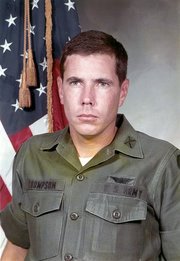
Thank you, Mr Thompson


Just learned this sad news yesterday (http://tinyurl.com/c9lho) : Hugh Thompson Jr., a former Army helicopter pilot honored for rescuing Vietnamese civilians from his fellow GIs during the My Lai massacre, died of cancer early Friday at the age of 62.

From Wikipedia (http://en.wikipedia.org/wiki/Hugh_Thompson%2C_Jr.):

Hugh C. Thompson, Jr. (April 15, 1943 - January 6, 2006) was a helicopter pilot during the Vietnam War. He is chiefly known for his role in stopping the My Lai Massacre, during which he was flying a reconnaissance mission.

Early in the morning of March 16, 1968, Thompson, door-gunner Lawrence Colburn and crew chief Glen Andreotta, came upon U.S. ground troops killing Vietnamese civilians in and around the village of My Lai.

They landed the helicopter in the line of fire between American troops and fleeing Vietnamese civilians and pointed their own guns at the U.S. soldiers to prevent more killings.

Colburn and Andreotta had provided cover for Thompson as he went forward to confront the leader of the U.S. forces. Thompson later coaxed civilians out of a bunker so they could be evacuated, and then landed his helicopter again to pick up a wounded child they transported to a hospital. Their efforts led to the cease-fire order at My Lai.

Exactly thirty years later, in 1998, the three men were awarded the Soldier's Medal (Andreotta posthumously for he died three weeks after the event), the United States Army's highest award for bravery not involving direct contact with the enemy.

In 1998, Thompson and Colburn returned to the village in My Lai, where they met with some of the villagers saved through their actions — including 8 year old Do Hoa pulled from an irrigation ditch. They also dedicated a new elementary school for the children of the village.

In a 2004 interview with 60 Minutes, Thompson was quoted referring to C-Company's men involved in the massacre, "I mean, I wish I was a big enough man to say I forgive them, but I swear to God, I can't."

Lt. William L. Calley, the platoon leader who directed the massacre, was convicted and sentenced to life imprisonment for his role in the killings, but served just three years under house arrest when then-President Nixon reduced his sentence.

Author Seymour Hersh won the 1970 Pulitzer Prize for his expose of the massacre in 1969 while working as a freelance journalist. In spite of a whitewash by Colin Powell (yes, that Colin Powell), the massacre became one of the pivotal events that fueled the growing opposition to the war in the United States.

Although Thompson's story was a significant part of Hersh's reports, and Thompson testified before Congress, his role in ending My Lai wasn't widely known until the late 1980s, when David Egan, a professor emeritus at Clemson University, saw an interview in a documentary and launched a letter-writing campaign that eventually led to the awarding of the medals in 1998.

For years Thompson suffered snubs and worse from those who considered him unpatriotic. He recalled a congressman angrily saying that Thompson himself was the only serviceman who should be punished because of My Lai.

As the years passed, Thompson became an example for future generations of soldiers, and went to West Point once a year to give a lecture on his experience.

There are so many people today walking around alive because of him, not only in Vietnam, but people who kept their units under control under other circumstances because they had heard his story. We may never know just how many lives he saved.

Rest in peace, Hugh Thompson Jr.


More links about Hugh Thompson Jr.: http://tinyurl.com/65al8,
http://tinyurl.com/bnwyg
http://www.pbs.org/wgbh/pages/frontline/programs/transcripts/714.html


Friday, January 06, 2006

When dogs pout and kangaroos gossip

I have no idea whether kangaroos gossip, the title of this post is just a spoof of a nature documentary called «When elephants cry and chimpanzees laugh» or something like that. I thought it would be a cool segue into bragging about my dog Toast a.k.a Loulou.

Here she is, my Princess:


Uh..no, wait. This shot was taken when she was drunk. Let me find a better picture.
......

OK, here's a better one:


Anyhoo, Loulou sleeps in my bed every night (yep, that's how pathetic my sex life is). But the other night, as I was massaging her before she goes to sleep as usual, I noticed that her collar was a bit tight, so I removed it to loosen it. Boy, was she mad! Normally she hates to be without her collar but that night she was particularly testy, growling and pacing. Once I have stretched out her collar a bit, I tried to put it back on her, but she was furious and left the room in a huff. That night, she slept in the living room, refusing to return to my bed despite all my pleas.

Another night, my son Asparagus was teasing her, poking her with her rope toy, trying to make her bite the rope and play the pulling game. But she was in no mood to play, so after a while, she did take the rope in her mouth, but then she just went and spit it out in the waste basket, and went back to sleep on the sofa. One can imagine that, if she had hands, she would have probably wiped them in a dismissive way, saying: «There! No more of that nonsense!»

In conclusion, as a result of these conclusive and scientific observations, I can certify that dogs pout and do not suffer fools gladly.

Kangaroos' gossiping habits are still under study.

Thursday, January 05, 2006

Age is just an artifact of the mind

Our family has this neat tradition where on Christmas eve, my ex comes to our house for supper and present exchange with his two post-divorce children, while on New Year's eve, his pre-divorce children and I go to his restaurant for a big all-you-can-eat buffet and party. We followed tradition again this year (or rather last year, but you know what I mean) and we all had a great time.

At the New Year's eve party, the restaurant provided two dancing areas: one for the younger crowd with a DJ and non stop dancing and another with a live band for the old coots. Our table was situated in the old coots area so the younger members of our group disappeared frequently to go and boogie at the other dancing area. My son Asparagus, who did not want to dance, and I were stuck with the live band. The band was composed of three guys, in their mid-late fifties: lead guitar, rythm guitar and drums. Even though their repertoire was mainly rock n' roll and oldies, their audience of old timers not only danced eagerly, they also complained loudly and rightly that the band took too many breaks.

As I was watching them dance, a thought suddenly hit me: the band, the dancers, they were all my contemporaries! Here I was, smugly laughing at the band's lack of stamina or at the dancer's grey hair, rotund shapes and shaky steps, never realizing that I was a member of the same generation. No white hair for me (Thank you L'Oreal!) but the same rotund shape and probably the same shaky steps, had I had the courage to step on the dance floor like them. The crusty lead singer, who was cultivating a vague resemblance to Mick Jagger, was probably feeling as young as my Asparagus. And the old ladies who were shaking their booties probably never considered themselves «old ladies».

Just this morning, I read an article entitled: «50 is the new 30». I'm sure that in a few years, there will be an article called: «60 is the new 40». The whole baby boomer generation is trying as hard as it can to fight back the aging process and, because of its sheer number, it may very well succeed in convincing itself and the rest of the world of its continuing relevance.

Wednesday, January 04, 2006

Tuesday, January 03, 2006

More cunning linguists, but this time Vietnamese ones

I was intrigued by a recent article posted at Vietnam Net Bridge (http://tinyurl.com/7lp68) entitled: «Vietnamese translators killing international authors». Being a Vietnamese and a translator, I was of course wary about potential competition (not to mention, I've always wanted to be a ninja assassin cum translator) so I checked them out.

«Many foreign books have been translated into Vietnamese in the past 15 years and many of them contained major errors in translation. Are translators assassinating foreign authors’ works?

Recently, the Culture and Information Publishing House released a very badly translated version of the American novel ‘The Da Vinci Code.’

Vietnamese translators have worked individually, relying on personal talent. Thus far, no one has been successful in regulating a standard level of translation. Many international poets and authors have their work severely changed when it’s translated into Vietnamese. In the other words, their works are killed by translators.

There is currently no agency overseeing the translation of books into Vietnamese. Many are worried that the current situation offers no transparency in the translation process and few opportunities for quality control.

Many young talented translators are not being given the opportunity to work with international literature of any consequence. They are ignored by publishers because they apparently lack the prestige and experience of their older counterparts. What they actually lack is simply the relationships to get their foot in the door. Consequently, there is a lack of realistic youthful voices in translated literature.

For many years, Russian poetry was considered the epitome of literature in Vietnam. Now, one must wonder if the translations were good in the first place. According to many experts, Vietnamese translators have been assassinating Russian poets for quite some time.

Of course any translator faces a colossal task when attempting to translate a work of literature between two languages. All we can ask is that they do their best. However, it is important that the safeguards are in place so the public knows that the version they are reading is as close to the intentions of the author as possible.»


Phew! No competition there. My job is safe. On the other hand, I have read many English translations of Vietnamese novels and poems that are full of mistakes. The latest example is «Spring Essence: The Poetry of Ho Xuan Huong» (http://tinyurl.com/a3u6z), a compilation of poems by one of Vietnam most famous poetesses translated by poet and translator Balaban. Despite his valiant efforts, Balaban could not reproduce Ho Xuan Huong's playful wit or her mischievious sexual double entendres and even introduced some blatant mistranslations.