Que les puces d'un millier de chiens galeux infestent le cul de celui qui vous gâchera une seule seconde de votre année 2006, et que les bras de cet abruti deviennent trop courts pour qu'il ne puisse jamais se le gratter...
Bonne et heureuse année!!
Que les puces d'un millier de chiens galeux infestent le cul de celui qui vous gâchera une seule seconde de votre année 2006, et que les bras de cet abruti deviennent trop courts pour qu'il ne puisse jamais se le gratter...

«We must invade their countries, kill their leaders, convert them to Christianity, bomb their homes, burn their families with Willy Pete, rig their elections, kidnap their wives, rape their children before them, and murder them casually, trading photographs of the bodies online for porn.
Only then shall we be safe. Only then shall we be respected. Only then shall we be loved. Only then shall we enter Heaven.»
Happenstance | 01.29.06 - 5:25 am
«In the 1930s Ye Peiji, the head of the Imperial Palace Museum, said that if culture is lost it’s gone forever. When I visited Vietnam I learned that the Vietnamese people once used Chinese characters. But because a French missionary invented a romanization method in order to spread Christianity, Vietnamese people gradually began not to use Chinese characters and instead used romanization for their language. In Vietnam, I discovered that their writers’ works all use romanization. Thus, the foundation for Vietnamese culture appears to be extremely superficial. This immediately brought to mind Ye Peiji’s words.»I was first alerted to Mr. Chén's comment by Noodlepie [http://noodlepie.typepad.com/blog/] and I immediately went to post my own comment. Later on, as the word spreads, more comments appeared, all condemning Chén's ignorance and arrogance.
«Ca Dao Viet Nam: Vietnamese Folk PoetryTranslating Vietnamese into English is hard; translating Vietnamese folk poems into English is much harder, or nearly impossible. I applaud John Balaban for taking on the challenge, but some of his interpretations in Ca Dao Viet Nam don’t do it for me. The folkloric tradition, witty wordplays, and lyrical esthetics are lost in transformation.
He translates, “Gio dua trang” as “The wind plays with the moon.” Why plays, and not swings? When he switches the order of “Lon len co hoc, em oi” to “Study hard, little one, grow up,” he has changed the meaning of the sentence, and it sounds quite awkward. As if we’re telling the little one to hungry and grow up so that we don’t have to take care of him anymore, instead of telling him to study hard when he grows up.
“Perhaps I must leave you” is too disruptive and harsh compares to “Co hoi nay anh danh doan bo em.” And “Bad beer soon sends you home” is nowhere near the lyrical harmony of “Ruou lac uong lam cung say.” Why bad beer for ruou lac, and not plain wine? Yet, what baffles me the most is: “Uong an kham kho biet phan nan cung ai? / Phan nan cung truc, cung mai” (“The body is pain. I can’t complain. / My food is bamboo shoots and plums”). Where do the bamboo shoots and plums come from? Besides, those two aren’t classified as kham kho (poverty-stricken) food either.
I am in no way of trying to castigate Mr. Balaban for what he did. In fact, for a foreigner to come up to the people during the war and ask them to sing their favorite folk tunes takes tremendous courage, and he did it. I have respect for him; therefore, I am just simply pointing out the things that don’t work for me. So it is nothing personal.»
«One U.S. Liberal's Advice to Progressive Canadians: Don't Make The Same Mistake We Did!
I should state first that I am an American. But I am also a student of Canadian politics. Here's how next week's election looks to this south-of-the 49th parallel progressive.
A week from today, Canadians will face a choice:
To go forward on a nuanced path toward social justice for all, equal rights for all who consensually choose to love, environmental consciousness, guaranteed health care for everyone, continued separation of church and state, and the perpetuation of Canada's image as a nation that does not reflexively choose war every time fear raises its ugly head.
The other choice:
To slide back from what makes Canada special. Allowing profit-minded private enterprise to compete for, or even subsume, guaranteed national health care; cut back social programs in the name of budgetary efficiency; propose referenda that if approved, would deny all adult Canadians the right to marry who they love; enact de jure or de facto rollbacks of environmental safeguards, strip down Canada's national rail system, let religious teachings slip into civic and even governmental life.
Such a fate awaits a Canada with the Conservatives, and their quite socially and economically conservative leader Steve Harper in power.
Would it be that the choice was so clear, though.
The current majority party, the Liberals, have been in power for 12 years. In recent years under the stewardship of Prime Minister Paul Martin, scandal and impropriety have not been absent from the halls of power. Although Martin has not been even indirectly implicated thus far, the most charitable statement one might make is that he hasn't always chosen his associates wisely.
For my fellow progressives who live north of the 49th, the obvious alternative would be the NDP (New Democratic Party). They are the ones with a truly fair agenda that does not give the slightest bit of deference to parsimoniousness in the name of budgetary efficiency. Personified by their enlightened leader, Jack Layton, the NDP is the party that will stand for justice, peace, and environmental stewardship against the same type of intolerant and greedy forces that besmirch our civic and social life here in the States.
But NDP cannot win, at least nationally. They have strength in the cities and even a few select rural ridings, but as I and the polls see it, they just don't have national heft.
As an American, this current Canadian election reminds me of our 2000 elections. A Democratic administration was coming off an impeachment controversy, and a very conservative Republican was running as a "compassionate conservative." The progressives flocked to NDP kindred spirit Ralph Nader, while too many moderates and liberals voted for Bush in the belief that for ethical reasons the party controlling the executive branch had to change- and that Bush couldn't be all that conservative.
Well, those Nader votes as well as those of defecting liberals and moderates cost Al Gore the election. Now, here in the States, we are about to confirm a Bush-nominated Supreme Court nominee who, by his statements and his record, embraces the power of the central government, is opposed to a woman's right to choose, and would likely vote to roll back the separation of church and state.
I am seized with the parallels between the 2000 U.S. Presidential election and what you Canadians are facing right now. Well-meaning progressive voters pulled the lever for their passions rather than vote pragmatically.
I know that it is tempting for you Canadian progressives tired of scandal to vote NDP, sit this one out, or vote for the Conservative Party in the hopes that they won't be all that conservative.
But I have to tell you that many of us (not me, but many fellow progressives) made that mistake back in 2000. And we are about to pay for it in ways that frankly, are both depressing and a bit scary.
Canadian progressives, please don't make the same mistake we did in 2000. Vote with your head, not your heart. The NDP can't win, and an ethically challenged, moderately progressive party is a better choice than a socially conservative party embraced in the halls of business and by members of evangelical megachurches.
I know the choice is not appealing, but to me, it is clear. Vote Liberal, and keep Martin around.»
To this, I would add that my intention was to vote for the Greens, but I realize of course that they have even less chance of being elected than the NDP. And yet, I'm not sure I can pinch my nose long enough to vote for the Liberals. Some shits are just too deep and too smelly. On the other hand, I would rather cut off my arm than to vote for Harper, the Blair wannabe. No, I take it back. Harper is worse than Blair in his slavish loyalty to Bush, he is what Jacques Brel called «l'ombre de son chien», not even his lapdog, but the lapdog's shadow.
Also, don't forget to read the comments to Mr. Shaw's post, where he gets smacked down and yelled at by irate Canadian readers.
It seems that the main stream media has been mostly ignoring the life and death of Captain Hugh Thompson Jr. So I am reproducing below another text about this American hero, as posted by Clancy Sigal at Counterpunch (http://www.counterpunch.org/sigal01122006.html).
Some of the people commenting on blogs about Thompson said: «I didn't know that. I've never heard of MyLai before». They probably know more about inconsequential facts like Ashley Simpsons lipsyncing incident on Saturday Night Live. So, here's to you, Captain Thompson.
Hugh Thompson and My Lai
By Clancy Sigal
There is an Ugly American, a Quiet American and then there's Hugh Thompson, the Army helicopter pilot who, with his two younger crew mates, was on a mission to draw enemy fire over the Vietnamese village of My Lai in March, 1968. Hovering over a paddy field, they watched a platoon of American soldiers led by Lt. William Calley, deliberately shoot unarmed Vietnamese civilians, mainly women and children, cowering in muddy ditches. Thompson landed his craft and appealed to the soldiers, and to Calley, to stop the killings. Calley told Thompson to mind his own business.
Thompson took off but then one of his crew shouted that the shooting had begun again. According to his later testimony, Thompson was uncertain what to do. Americans murdering innocent bystanders was hard for him to process. But when he saw Vietnamese survivors chased by soldiers, he landed his chopper between the villagers and troopers, and ordered his crew to fire at any American soldiers shooting at civilians. Then he got on the radio and begged U.S. gunships above him to rescue those villagers he could not cram into his own craft.
On returning to base, Thompson, almost incoherent with rage, immediately reported the massacre to superiors, who did nothing, until months later when the My Lai story leaked to the public. The eyewitness testimony of Thompson and his surviving crew member helped convict Calley at a court-martial. But when he returned to his Stateside home in Stone Mountain, Georgia, Thompson received death threats and insults, while Calley was pardoned by President Nixon. Indeed, for a time, Thompson himself feared court-martial. Reluctantly, the massacre was investigated by then-major Colin Powell, of the Americal Division, who reported relations between U.S. soldiers and Vietnamese civilians as "excellent"; Powell's whitewash was the foundation of his meteoric rise through the ranks.
Hugh Thompson died last week, age sixty two. Thirty years after My Lai, he, and his gunner Lawrence Colburn, had received the Soldiers Medal, as did the third crew member, Glenn Andreotta, who was killed in combat. "Don't do the right thing looking for a reward, because it might not come," Thompson wryly observed at the ceremony.
Something stuck in my head when I learned of Thompson's death. "There was no thinking about it," he said before his death. "There was something that had to be done, and it had to be done fast."
Words similar to these are often used by combat heroes to describe incredible feats of courage under fire. With one possible difference. According to the record, Thompson did have time to think about it as he took off from My Lai, hovered and tried to wrap his mind around the horror below. Then he made a conscious decision to save lives. Some of the Vietnamese he rescued, children then, are alive today.
Ex-chief warrant officer Thompson is a member of a small, elite corps of Americans who have broken ranks and refused to run with the herd. They include Army specialist Joseph Darby, of the 372d Military Police Company, who reported on his fellow soldiers who were torturing prisoners at Abu Ghraib prison. His family has received threats to their personal safety in their Maryland hometown. And Captain Ian Fishback, the 82d Airborne West Pointer, who served combat tours in Iraq and Afghanistan, and tried vainly for seventeen months to persuade superiors that detainee torture was a systematic, and not a 'few bad apples', problem inside the U.S. military. In frustration, he wrote to Senator McCain, which led directly to McCain's anti-torture amendment. I wouldn't want to bet on the longevity of Captain Fishback's military career.
Thompson's death also reminded me of Captain Lawrence Rockwood, of the 10th Mountain Division. Ten years ago, Rockwood was deployed to Haiti where, against orders, he personally investigated detainee abuse at the National Penitentiary in the heart of Port au Prince. He was court-martialed for criticizing the U.S. military's refusal to intervene, and kicked out of the Army. While still on duty, he kept a photograph on his desk of a man he greatly admired. It was of Captain Hugh Thompson.
Some of my friends get so angry at the Bush White House, and so despairing, that they slip into a mindset where Americans - the great 'Them' out there - are lumped into a solid bloc of malign ignoramuses. They forget that this country is also made up of people like Hugh Thompson, Joe Darby, Ian Fishback and Lawrence Rockwood - outside and inside the military.

Tears from crushed petal She-Alito*.
And didn’t they also make Baby Jesus
Cry with their «Happy Holidays»?
*http://abcnews.go.com/WNT/story?id=1495804
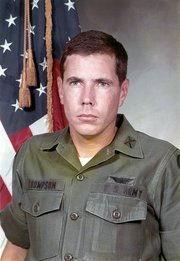
From Wikipedia (http://en.wikipedia.org/wiki/Hugh_Thompson%2C_Jr.):
They landed the helicopter in the line of fire between American troops and fleeing Vietnamese civilians and pointed their own guns at the U.S. soldiers to prevent more killings.
Colburn and Andreotta had provided cover for Thompson as he went forward to confront the leader of the U.S. forces. Thompson later coaxed civilians out of a bunker so they could be evacuated, and then landed his helicopter again to pick up a wounded child they transported to a hospital. Their efforts led to the cease-fire order at My Lai.
Exactly thirty years later, in 1998, the three men were awarded the Soldier's Medal (Andreotta posthumously for he died three weeks after the event), the United States Army's highest award for bravery not involving direct contact with the enemy.
In 1998, Thompson and Colburn returned to the village in My Lai, where they met with some of the villagers saved through their actions — including 8 year old Do Hoa pulled from an irrigation ditch. They also dedicated a new elementary school for the children of the village.
In a 2004 interview with 60 Minutes, Thompson was quoted referring to C-Company's men involved in the massacre, "I mean, I wish I was a big enough man to say I forgive them, but I swear to God, I can't."
Lt. William L. Calley, the platoon leader who directed the massacre, was convicted and sentenced to life imprisonment for his role in the killings, but served just three years under house arrest when then-President Nixon reduced his sentence. Author Seymour Hersh won the 1970 Pulitzer Prize for his expose of the massacre in 1969 while working as a freelance journalist. In spite of a whitewash by Colin Powell (yes, that Colin Powell), the massacre became one of the pivotal events that fueled the growing opposition to the war in the United States. Although Thompson's story was a significant part of Hersh's reports, and Thompson testified before Congress, his role in ending My Lai wasn't widely known until the late 1980s, when David Egan, a professor emeritus at Clemson University, saw an interview in a documentary and launched a letter-writing campaign that eventually led to the awarding of the medals in 1998. For years Thompson suffered snubs and worse from those who considered him unpatriotic. He recalled a congressman angrily saying that Thompson himself was the only serviceman who should be punished because of My Lai. As the years passed, Thompson became an example for future generations of soldiers, and went to West Point once a year to give a lecture on his experience. There are so many people today walking around alive because of him, not only in Vietnam, but people who kept their units under control under other circumstances because they had heard his story. We may never know just how many lives he saved. Rest in peace, Hugh Thompson Jr. More links about Hugh Thompson Jr.: http://tinyurl.com/65al8,
http://tinyurl.com/bnwyg
http://www.pbs.org/wgbh/pages/frontline/programs/transcripts/714.html


«Many foreign books have been translated into Vietnamese in the past 15 years and many of them contained major errors in translation. Are translators assassinating foreign authors’ works?
Recently, the Culture and Information Publishing House released a very badly translated version of the American novel ‘The Da Vinci Code.’
Vietnamese translators have worked individually, relying on personal talent. Thus far, no one has been successful in regulating a standard level of translation. Many international poets and authors have their work severely changed when it’s translated into Vietnamese. In the other words, their works are killed by translators.
There is currently no agency overseeing the translation of books into Vietnamese. Many are worried that the current situation offers no transparency in the translation process and few opportunities for quality control.
Many young talented translators are not being given the opportunity to work with international literature of any consequence. They are ignored by publishers because they apparently lack the prestige and experience of their older counterparts. What they actually lack is simply the relationships to get their foot in the door. Consequently, there is a lack of realistic youthful voices in translated literature.
For many years, Russian poetry was considered the epitome of literature in Vietnam. Now, one must wonder if the translations were good in the first place. According to many experts, Vietnamese translators have been assassinating Russian poets for quite some time.
Of course any translator faces a colossal task when attempting to translate a work of literature between two languages. All we can ask is that they do their best. However, it is important that the safeguards are in place so the public knows that the version they are reading is as close to the intentions of the author as possible.»
Phew! No competition there. My job is safe. On the other hand, I have read many English translations of Vietnamese novels and poems that are full of mistakes. The latest example is «Spring Essence: The Poetry of Ho Xuan Huong» (http://tinyurl.com/a3u6z), a compilation of poems by one of Vietnam most famous poetesses translated by poet and translator Balaban. Despite his valiant efforts, Balaban could not reproduce Ho Xuan Huong's playful wit or her mischievious sexual double entendres and even introduced some blatant mistranslations.
It's a heartwarming story, but it's a fraud. The reason we targeted the dog genome for decoding is that it's useful for genetic research. The reason it's useful for genetic research is that dogs are neatly divided into breeds, each of which is plagued by specific diseases. And the reason dogs are divided into diseased breeds is that we made them that way. Dogs are the world's longest self-serving, ecologically reckless genetic experiment, perpetrated by the world's first genetically engineering species: us.
Dogs were just a loose category of wolves until around 15,000 years ago, when our ancestors tamed and began to manage them. We fed them, bred them, and spread them from continent to continent. While other wolf descendants died out, dogs grew into a new species. We invented the dog.
We didn't pick just any wolves for this project. We picked the ones that could help us and get along with us. Dogs are dumber than monkeys and other mammals in many ways, but they excel at one thing: interpreting human behavior. Three years ago, scientists tested this talent in wolves, adult dogs, puppies raised in households, and puppies raised in kennels. The wolves couldn't read humans well, but the puppies could—even the puppies raised in kennels. Through selection, we've hardwired human compatibility into dogs. We've made a species in our image.
But that wasn't enough. We had specific needs. We bred hunting dogs, herding dogs, sled dogs, and guard dogs. (We also tried a few unauthorized uses.) We turned reproductive separation and inbreeding into a science, multiplying and dividing the species into more than 400 breeds. The American Kennel Club sorts them into the Sporting Group, Working Group, Herding Group, Hound Group (whose ancestors were "used for hunting"), Terrier Group (whose ancestors "were bred to hunt and kill vermin"), and Toy Group. "The diminutive size and winsome expressions of Toy dogs illustrate the main function of this Group: to embody sheer delight," says the club's Web site. Every dog has his duty.
Each need, each breed, called for special traits. We bred collies for vigilance, Rottweilers for aggression, retrievers for obedience. In a span of decades, we bred ferocity into Dobermans and then, with equal deliberateness, bred it out. We treated dogs like guns. We designed and bought them for protection, then complained when they hurt us. When cities banned pit bulls, we bought Rottweilers. It was as easy as replacing an illegal assault weapon with a legal one.
Not all our designs were utilitarian. We made some breeds just for fun. Some, like the Pharaoh Hound, were thought to be ancient because they looked like dogs drawn on Egyptian tombs. But last year, when we checked their DNS, we found no evidence they were older than modern breeds. Apparently, breeders crafted them by mating dogs that looked like the drawings. Life imitated art.
In the course of engineering dogs to look, feel, and act as we wanted, we ruined millions of them. We gave them legs so short they couldn't run, noses so flat they couldn't breathe, tempers so hostile they couldn't function in society. Even our best intentions backfired. Nature invented sexual reproduction to diversify gene pools and dilute bad variants. By forcing dogs into incest (which we ban among humans, in part for biological reasons), we defied nature. We concentrated each bad gene in a breed, magnifying its damage: epilepsy for springer spaniels, diabetes for Samoyeds, bone cancer for Rottweilers. That's why the dog genome is so nifty: We can find disease genes just by comparing one breed's DNA to another's.
Well, too bad for the dogs. But three cheers for us and our experiment. "The dog genome is a wonderful playground for geneticists," exults the New York Times. "A treasure trove," says the San Francisco Chronicle. "A convenient laboratory," agrees Reuters.
Man's best friend, indeed.
Also see Mr. Saletan's article about Designer dogs made to order: http://www.slate.com/id/2133349/
| You Should Get a PhD in Liberal Arts (like political science, literature, or philosophy) |
 You're a great thinker and a true philosopher. You'd make a talented professor or writer. |


My blog is worth $2,258.16.
How much is your blog worth?


